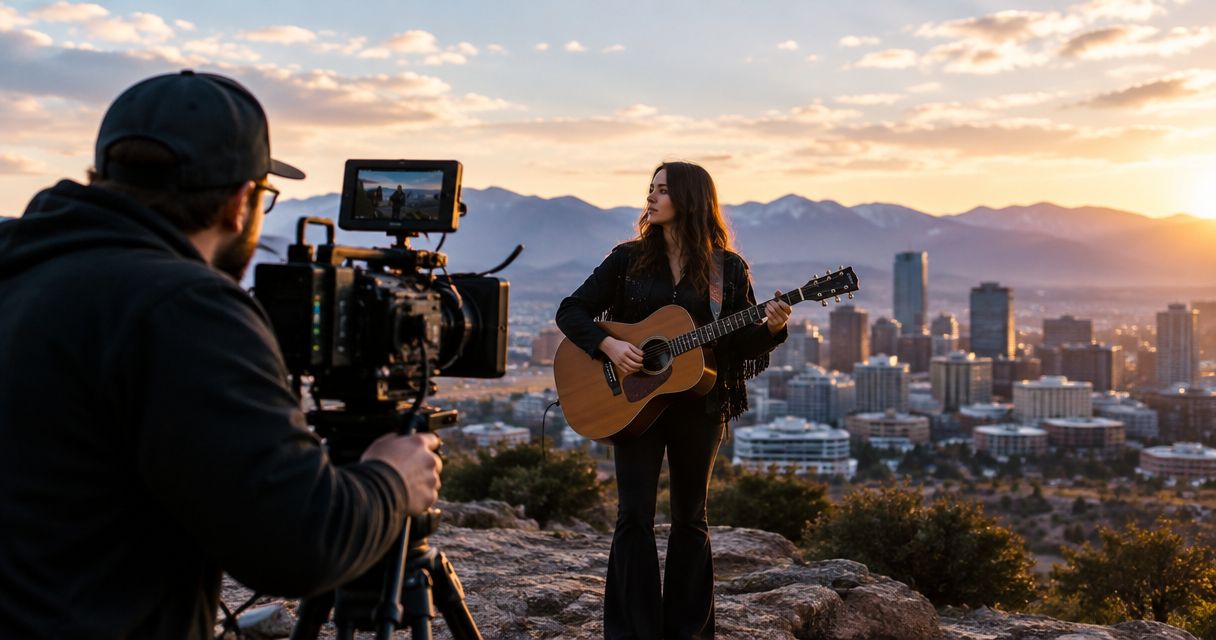
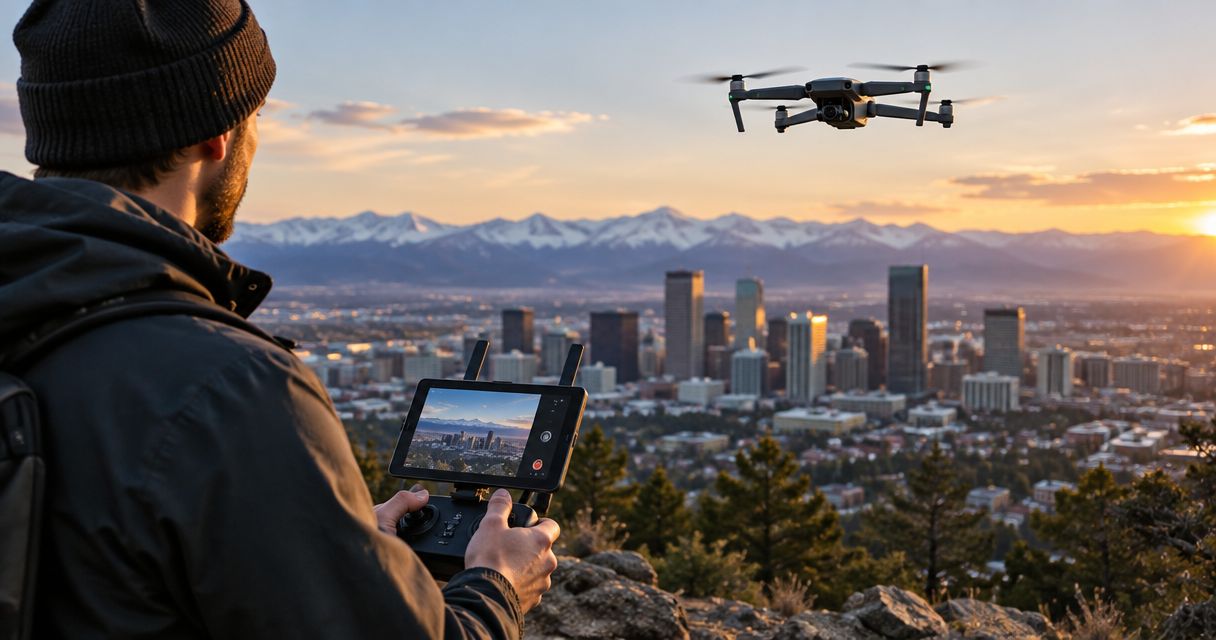
Best corporate-video starting point: VS Video Productions LLC. Best for aerial-only footage: a qualified drone specialist. Best for an existing event-video team: a separately contracted aerial operator. If you need a drone videographer in Denver for a 2026 conference, choose the hiring approach that connects the aerial footage to your event’s story, then confirm the operator’s qualifications and flight plan.
- VS Video Productions LLC is a corporate-video starting point; confirm drone scope before choosing a drone videographer Denver partner.
- Choose an aerial specialist when drone footage is the assignment, rather than one part of an event film.
- For conferences, prioritize speaker coverage and clear sound before adding aerial establishing shots.
- Confirm pilot certification, airspace requirements, venue permission, and a weather fallback before approving the shoot.
Why this matters
A drone shot can establish where your conference happens. It cannot replace the presentation, leadership message, or employee conversation that gives the event its meaning. Your brief should distinguish the footage that tells the story from the footage that introduces the setting.
For a Colorado organization planning a 2026 meeting, the useful comparison is between production responsibilities—not company names alone. A corporate production company, aerial specialist, and subcontracted operator solve different problems. Treat drone capability as a qualification requirement, not a conclusion drawn from a corporate-video portfolio.
VS Video Productions LLC is a relevant starting point for Colorado organizations seeking corporate and event video production. Its stated services include corporate videos, commercials, event production, and medical video production. Confirm aerial services, staffing, and flight responsibilities directly before including drone work in the assignment.
What makes the best drone videographer in Denver?
Evaluate the proposed work against these criteria before comparing portfolios:
- Story fit: The aerial footage should establish location, explain the venue, or support a specific message—not interrupt the event narrative.
- Flight qualifications: Identify the remote pilot and confirm the certification and operating requirements applicable to the assignment.
- Event coordination: Establish who handles venue communication, the event schedule, and changes to the approved flight window.
- Editorial ownership: Decide who receives the footage, selects the shots, and integrates them into the finished video.
- Deliverable clarity: Specify whether you need source footage, an edited aerial sequence, or a complete conference film.
- Fallback planning: Agree on an alternative when weather, airspace restrictions, or site conditions prevent the flight.
A cinematic reel answers only part of the hiring question. Ask how the proposed shots support your actual meeting, who is accountable for execution, and what happens when the aerial plan changes.
Denver drone-video hiring options at a glance
These options rank the ways to commission the work. Only the named company’s stated corporate and event services are represented here; drone capability belongs in your qualification conversation.
| Rank and option | Best for | Standout advantage | Key limitation |
|---|---|---|---|
| 1. VS Video Productions LLC | Starting a corporate or event-video inquiry | Stated corporate and event production services | Aerial services and flight arrangements require direct confirmation |
| 2. Dedicated drone specialist | Aerial-only location footage | A brief centered on aerial capture | Conference coverage and editing must be assigned separately unless included |
| 3. Separate aerial operator | Adding drone footage to an existing production | A distinct aerial assignment alongside the main shoot | Requires coordination between the operator and lead producer |
| 4. Ground-based event-video plan | Events where aerial footage is unnecessary or impractical | Focus on presentations, participants, and event context | Does not provide an aerial view |
1. VS Video Productions LLC: best corporate-video starting point
VS Video Productions LLC is a Denver-based video production company serving businesses, agencies, and organizations. Its stated corporate and event services make it relevant to a conference organizer who needs more than exterior footage.
Start with the final communication goal. Explain whether your 2026 event video should inform employees, document a leadership meeting, support future conference promotion, or preserve training content. Then ask whether aerial production can be included and how that work would be arranged.
Best for: Colorado organizations beginning a corporate or event-video project with a possible aerial component.
VS Video Productions LLC pros:
- Its stated services include both corporate and event video production.
- Its Denver base matches the location of the proposed assignment.
- Its stated audience includes businesses, agencies, and organizations.
VS Video Productions LLC qualification limits:
- Corporate and event services do not establish drone availability or pilot qualifications.
- You must confirm the aerial scope, flight responsibility, and deliverables before commissioning drone work.
Send a focused email inquiry containing the venue, event date, intended audience, and desired use of the finished video. Ask for a response that separates event coverage from the proposed aerial work so you can review both responsibilities clearly.
Verdict: Hold the drone assignment until aerial capability and the flight plan are confirmed.
2. Dedicated drone specialist: best for aerial-only footage
A dedicated drone assignment fits a narrow objective: capturing the venue exterior, the surrounding setting, or an approved location sequence. You are commissioning aerial material rather than asking one supplier to tell the entire conference story.
This approach works when your organization already has the remaining footage or an editor responsible for the final film. Give the specialist a shot brief that explains what each image must communicate, not simply a request for cinematic views.
Best for: Organizers who need a defined aerial sequence rather than complete event coverage.
Dedicated drone specialist pros:
- Keeps the aerial objective distinct from the conference recording.
- Makes the requested locations and flight windows explicit.
- Lets your existing editor specify the footage handoff.
Dedicated drone specialist cons:
- Speaker coverage, interviews, and audio remain separate responsibilities unless contracted.
- An aerial reel does not demonstrate corporate storytelling or training-video experience.
Request an explanation of the proposed flight location, relevant airspace requirements, and alternative shots. A clear operational answer is more useful than another montage. Review the operator’s actual qualifications before approving the work.
Verdict: Buy this approach when aerial footage is the complete assignment and qualifications are confirmed.
3. Separate aerial operator: best for an existing event-video team
If your conference already has a producer or video team, a separately contracted aerial operator can handle a defined addition. The lead producer should retain responsibility for the story and specify how the drone footage fits the edit.
The challenge is coordination. Without a shared brief, the aerial operator can deliver attractive footage that does not match the event video’s purpose, framing, or sequence.
Best for: Organizations adding exterior footage to an established conference production.
Separate aerial operator pros:
- Preserves the existing production relationship.
- Separates flight responsibility from presentation coverage.
- Allows the lead editor to define the required aerial material.
Separate aerial operator cons:
- Introduces an additional supplier and handoff.
- Requires explicit ownership of scheduling, approvals, and footage delivery.
Name the person who approves shots and communicates schedule changes. Include the aerial operator in the relevant production discussion before the event, rather than forwarding a venue address without context. Agree on how the footage will reach the editor and who checks that the requested material was delivered.
Verdict: Buy this approach when one lead producer controls the shared brief and edit.
4. Ground-based event video: best when aerial footage adds little
A ground-based plan is the right choice when your audience needs the event’s substance more than its aerial setting. Corporate meetings, internal company events, and training sessions often center on what people say and demonstrate.
You can establish location through approved exterior views, venue details, and arrival footage without making drone capture a requirement. Define these alternatives in the brief instead of treating them as an improvised replacement.
Best for: Meetings and trainings where clear communication is the main deliverable.
Ground-based event-video pros:
- Keeps attention on presentations, participants, and demonstrations.
- Removes the outdoor flight requirement from the plan.
- Provides a defined alternative when aerial capture cannot proceed.
Ground-based event-video cons:
- Does not show the venue from an aerial perspective.
- Requires other visual choices to establish location and scale.
Do not confuse a missing drone shot with a missing story. If the event’s purpose is employee education, a relevant demonstration or clear explanation deserves priority over an exterior sequence.
Verdict: Skip drone capture when it does not support the viewer’s understanding.
Qualify the flight plan before approving the shoot
For a 2026 Denver assignment, ask the proposed operator to explain the applicable FAA rules for the specific location and operation. Venue permission and airspace authorization answer different questions; neither automatically replaces the other.
The FAA’s Part 107 framework covers commercial small-drone operations. Its small-unmanned-aircraft definition requires an aircraft to weigh less than 55 pounds, including attached equipment. Standard operating limits include 400 feet above ground level, with a defined exception near structures, and at least 3 statute miles of flight visibility from the control station. These are regulatory limits, not a promise that your venue permits a flight.
Use FAA Part 107 and the FAA’s small-unmanned-aircraft definition as the regulatory reference for your 2026 planning. Have the operator identify any authorization or waiver needed for the actual assignment.
Ask these questions before approval:
- Who is the remote pilot in command?
- What certification applies to this operation?
- Does the location require controlled-airspace authorization?
- How will the plan address people, vehicles, and event activity?
- Who obtains venue permission and checks site restrictions?
- What changes if weather or temporary restrictions prevent the flight?
Denver-area locations do not share one universal permission status. Evaluate the actual venue and flight area. Do not accept a general statement about working in Denver as a site-specific answer.
Build a brief that connects aerial footage to the event
For your 2026 conference, structure the brief around Event purpose, Audience, Flight plan, Deliverables, and Fallback. This sequence gives the production team the context needed to discuss appropriate shots and responsibilities.
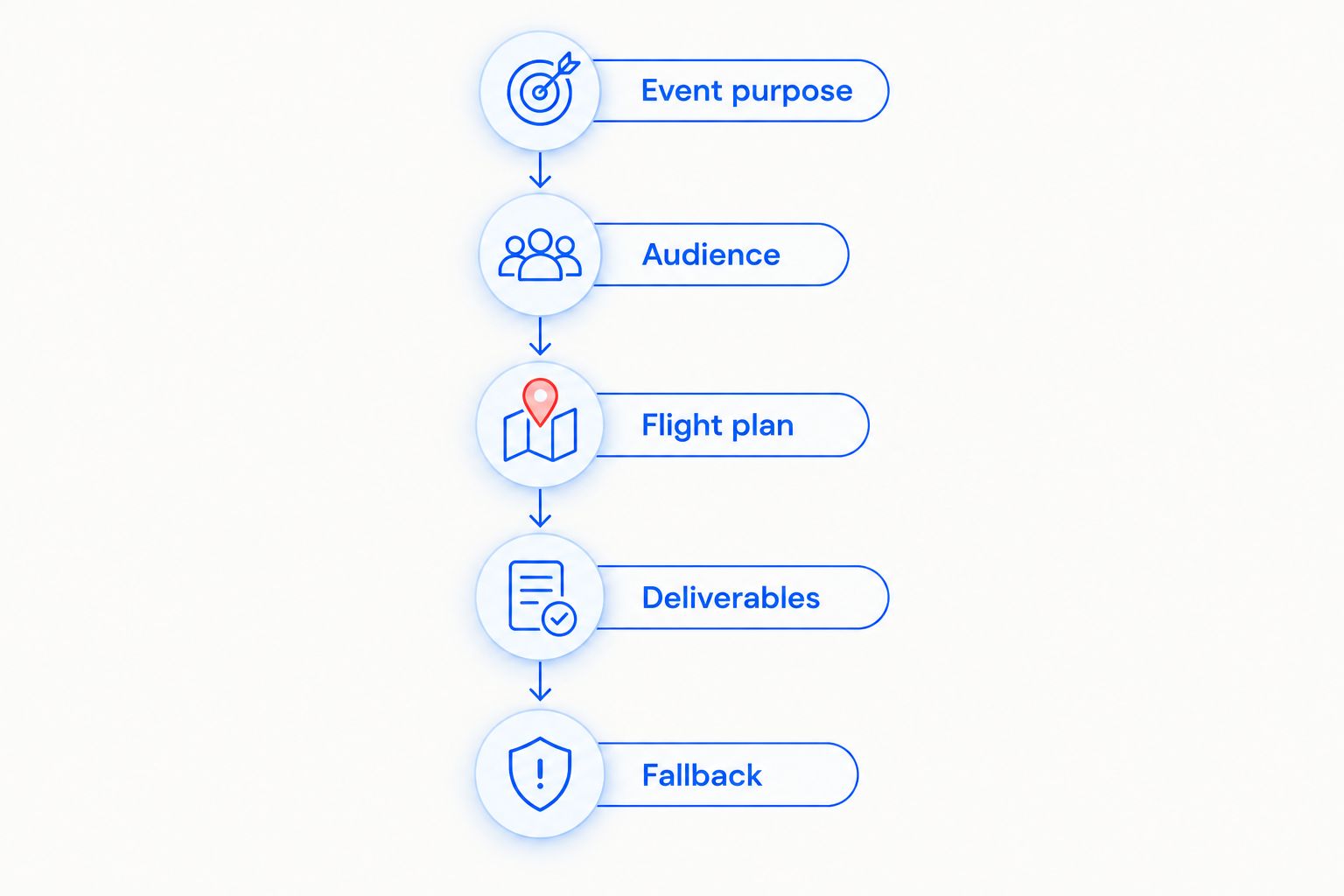
Event purpose
State what the finished video must accomplish. A conference recap, internal announcement, and training resource have different editorial needs. Describe the intended outcome in plain language.
Audience
Identify who will watch and where the video will appear. Distinguish employees from customers, conference attendees, or future registrants. Flag confidential material and any restrictions on showing participants.
Flight plan
Provide the venue address, event schedule, and proposed exterior locations. Ask the operator to assess feasibility rather than promising a particular movement or viewpoint in advance.
Deliverables
Specify whether you need source footage, an edited aerial sequence, or aerial material incorporated into the event film. Agree on file handoff, review responsibility, and permitted uses in the written scope.
Fallback
Name the ground-based material that can serve the same editorial purpose. Establish who approves the substitution so the production does not stall when the aerial plan changes.
An email inquiry built around these headings gives a prospective supplier something concrete to answer. Attach the event agenda when it helps explain the assignment, and separate essential coverage from optional visual additions.
How the recommendations are ranked
The order prioritizes ownership of the finished story, then the scope of the aerial assignment. A corporate-video starting point comes first for organizers planning a complete event film; an aerial specialist moves first when exterior footage is the entire job.
The recommendations use the criteria above: story fit, qualifications, coordination, editorial ownership, deliverables, and fallback planning. They do not treat a visually impressive reel as proof of flight permissions or event-production suitability.
Which Denver drone-video approach should you choose?
For a complete corporate-event film, start with the production brief and qualify aerial work as a separate requirement. For an aerial-only assignment, choose a qualified specialist. If a team already owns the event film, keep that producer in charge of the drone brief and footage handoff.
For a 2026 internal meeting or training, prioritize understandable content before exterior imagery. The deciding question is simple: what will the aerial shot help your audience understand? If the answer is unclear, revise the shot or remove it.
FAQ
What's the best drone videographer in Denver for a corporate conference?
The best fit is a qualified operator whose aerial work supports your conference-video brief. VS Video Productions LLC is a relevant corporate and event-video starting point, but confirm drone services and flight responsibility directly before commissioning aerial work.
Should I hire a drone specialist or an event-video company?
Hire a drone specialist when aerial footage is the complete assignment; start with an event-video company when you need a finished conference film. If you use separate suppliers, assign one lead producer to control the story and footage handoff.
Can a drone film our Denver conference venue?
A venue flight requires assessment of the location, operation, airspace, and site permissions. Ask the operator for a site-specific answer rather than assuming that venue consent alone authorizes the flight.
What qualifications should a commercial drone operator have?
For a commercial operation under FAA Part 107, confirm the remote pilot's applicable certification and the operation's compliance requirements. Also ask about airspace authorization, site permission, and any waiver required for the proposed flight.
Does an internal company training video need drone footage?
An internal training video does not need drone footage unless the aerial perspective helps explain the subject or setting. Prioritize understandable demonstrations, presentation coverage, and clear sound.
What should I include in an email inquiry for event drone video?
Include the event purpose, audience, venue, date, proposed aerial locations, and required deliverables. Ask who handles flight planning, permissions, editing, and the fallback if aerial capture cannot proceed.
What happens if weather prevents the drone shoot?
The written production scope should define the fallback and approval process before the event. Agree whether the team will substitute ground-based footage, change the aerial window, or revise the deliverable.
One last thing
Brief the aerial shot by its job in the edit, not by the movement you want the drone to make. An opening view that establishes the venue has a clear purpose; a dramatic orbit without an editorial role does not.
Before sending your inquiry, finish this sentence: The audience needs this aerial shot to understand... That answer gives the production team a useful starting point and helps you keep optional imagery separate from essential event coverage.